Enzymes are highly specific catalysts for biochemical reactions, with each enzyme showing a selectivity for a single reactant, or substrate. For example, the enzyme acetylcholinesterase catalyzes the decomposition of the neurotransmitter acetylcholine to choline and acetic acid. Many enzyme–substrate reactions follow a simple mechanism that consists of the initial formation of an enzyme–substrate complex, ES, which subsequently decomposes to form product, P, releasing the enzyme to react again.
E + S ↔ E–S ↔ E + P
The rate of product formation for this reaction is
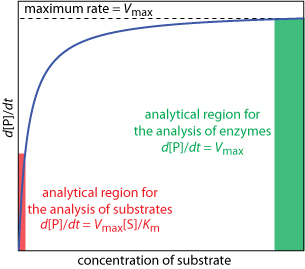
where k2 is the rate of the conversion of the enzyme-substrate complex, E–S, to product, [E]0 is the enzyme’s initial concentration, [S] is the substrate’s concentration, and Km is a constant called the Michaelis constant. A plot of this equation is shown here.

For high concentration of substrate, highlighted in green, the rate equation simplifies to
where Vmax is the reaction’s maximum rate. Under these conditions we can use the reaction’s rate to determine the concentration of enzyme. For small concentrations of substrate, the area highlighted in red, the rate equation simplifies to
and we can use the rate to determine the concentration of substrate.