For an enzyme–substrate reaction following a simple mechanism
E + S ↔ E–S ↔ E + P
consisting of the initial formation of an enzyme–substrate complex, ES, and its subsequent decomposition to form the product, P, and to release the enzyme to react again, the rate of product formation for this reaction is
where k2 is the rate of the conversion of the enzyme-substrate complex, E–S, to product, [E]0 is the enzyme’s initial concentration, [S] is the substrate’s concentration, and Km is a constant called the Michaelis constant. A plot of this equation is shown here.

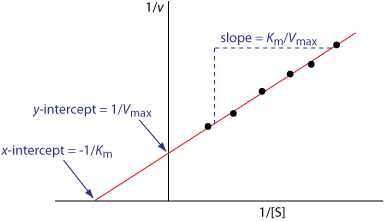
As suggested above, we can find values for Vmax and Km by measuring the reaction’s rate at very small and very large concentrations of the substrate. Unfortunately, this is not always practical as the substrate’s limited solubility may prevent us from using the large substrate concentrations needed to determine Vmax. Another approach is to rewrite the reaction’s rate equation by taking its reciprocal
where v is the reaction’s rate. As shown below, a plot of 1/v versus 1/[S], which is called a double reciprocal or Lineweaver–Burk plot, is a straight line with a slope of Km/Vmax, a y-intercept of 1/Vmax, and an x-intercept of –1/Km.