In a thermogravimetric analysis we measure the mass of a sample while heating the sample over time. The top photo shows a typical thermogravimetric analyzer and the bottom photo shows a close-up of the balance pan that holds the sample, the opening to the furnace, a hook connected to a balance for measuring mass, and a thermocouple for measuring temperature. After placing a small portion of the sample on the balance pan, the platform rotates over the furnace and transfers the balance pan to the hook. Once the balance pan is in place, the platform rotates back to its initial position. The balance pan and the thermocouple are then lowered into the furnace.


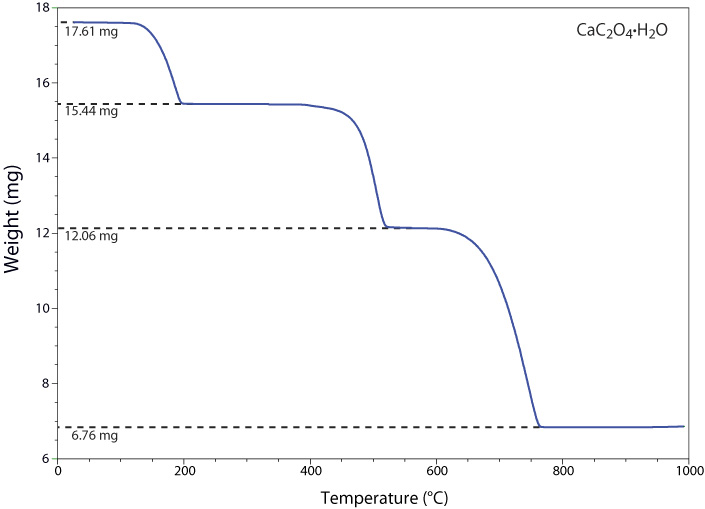
Shown here is a typical thermogram for CaC2O4•H2O, which was obtained by heating a sample from room temperature to 1000 oC at a rate of 20 oC/min. Each change in mass results from the loss of a volatile product. The sample’s initial mass and its mass after each loss are shown by the dotted lines. The sample’s decomposition takes place in three steps: the loss of H2O, leaving CaC2O4; the loss of CO2, leaving CaCO3, and the further loss of CO2, leaving CaO.