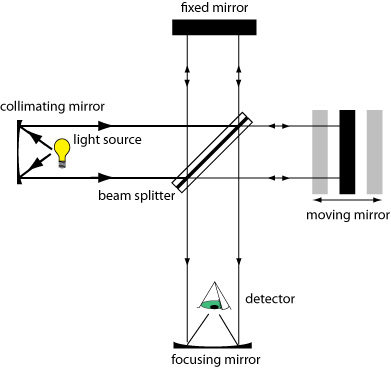
An interferometer provides an alternative approach for wavelength selection. Instead of filtering or dispersing the electromagnetic radiation, an interferometer allows source radiation of all wavelengths to reach the detector simultaneously, as illustrated below.

Radiation from the source is focused on a beam splitter that reflects half of the radiation to a fixed mirror and transmits the other half to a movable mirror. The radiation recombines at the beam splitter, where constructive and destructive interference determines, for each wavelength, the intensity of light reaching the detector. As the moving mirror changes position, the wavelengths of light experiencing maximum constructive interference and maximum destructive interference also changes. The signal at the detector shows intensity as a function of the moving mirror’s position, expressed in units of distance or time. The result is called an interferogram, or a time domain spectrum. The time domain spectrum is converted mathematically, by a process called a Fourier transform, to a spectrum (also called a frequency domain spectrum) showing intensity as a function of the radiation’s energy. Because the detector monitors all frequencies simultaneously, an entire spectrum takes approximately one second to record, as compared to 10–15 minutes with a scanning monochromator.