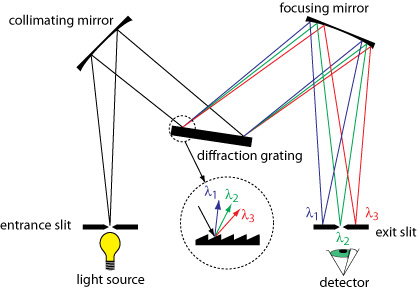
An absorption filter has one significant limitation—because a filter has a fixed nominal wavelength, if you need to make measurements at two different wavelengths, then you need to use two different filters. A monochromator provides an alternative method for selecting a narrow band of radiation that also allows us to continuously adjust the band’s nominal wavelength. The construction of a typical monochromator is illustrated here.

Radiation from the source enters the monochromator through an entrance slit. The radiation is collected by a collimating mirror, which reflects a parallel beam of radiation to a diffraction grating. The diffraction grating is an optically reflecting surface with a large number of parallel grooves. The diffraction grating disperses the radiation and a second mirror focuses the radiation onto a planar surface containing an exit slit. The choice of which wavelength exits the monochromator is determined by rotating the diffraction grating. A narrower exit slit provides a smaller effective bandwidth and better resolution, but allows a smaller throughput of radiation.